How to Add Your Corporate Logo to Custom Omamori: Printing vs. Embroidery
2026-10-30
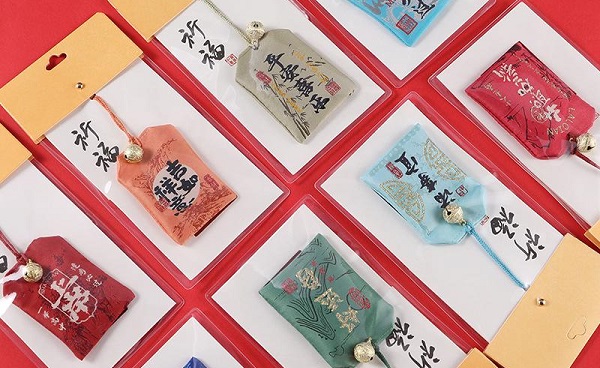
Adding a corporate logo to a custom omamori comes down to two main decisions: where the logo goes, and how it is applied. For small, detailed logos, printing is usually the more practical choice because it preserves fine lines and full colour. For a premium, tactile finish on fabric pouches, embroidery is the stronger option, provided the logo is simple enough to be stitched cleanly. The best placement is normally the front face of the pouch, with the back reserved for a short message or the drawstring area, and the inside used only when the design is intended as a hidden keepsake.
This guide explains the technical differences between silk screen printing, UV printing, heat transfer, and embroidery for omamori, then sets out placement and small-space design rules, and closes with a Hong Kong corporate event case study. The aim is to give procurement and marketing teams a clear basis for approving a logo application before sampling.

Best Placement for Your Logo (Front, Back, or Inside the Pouch)
Placement determines how visible the brand is and how much space is available for the logo artwork. On a typical omamori of around 4 × 6 cm or 5 × 7 cm, the usable front area is small, so the logo must be sized and positioned with care. The front face is the default choice for brand visibility. The back is better for a secondary message, a date, or a small mark. The inside is only suitable for a hidden keepsake or a card insert.
| Placement | Visibility | Best use | Limitations |
|---|---|---|---|
| Front face | Highest | Main corporate logo, event mark, campaign icon | Limited space; fine details may need simplification |
| Back face | Medium | Short message, event date, secondary logo | Less visible when the pouch is displayed front-facing |
| Inside the pouch | Low | Hidden keepsake, printed card insert, personal note | Not suitable for brand visibility; requires opening the pouch |
| Drawstring / tassel area | Medium | Small woven label or tag with brand name | Very limited space; text only in most cases |
In practice, a front-face logo with a back-face message is the most efficient combination. It keeps the brand clearly visible while using the reverse side for the campaign details. If the pouch is going to be photographed or displayed on a table, the front face should carry the highest-contrast version of the logo, and the back can hold a smaller, lighter mark.
Printing vs. Embroidery: Which is Better for Omamori?
Printing and embroidery are not interchangeable. Each has a specific behaviour on fabric, and the right choice depends on the logo complexity, the fabric type, and the intended finish. The technical definitions below are the ones to confirm with a supplier before sampling.
| Method | How it works | Best for | Limitations | Relative cost |
|---|---|---|---|---|
| Silk screen printing | Ink is pushed through a mesh stencil onto the fabric | One- or two-colour logos, bold shapes, text | Each colour needs a separate screen; not ideal for gradients | Low at volume |
| UV printing | UV-curable ink is printed directly onto the surface and cured instantly | Full-colour logos, fine detail, gradients | Ink sits on the surface; may feel slightly raised | Medium |
| Heat transfer | Printed transfer film is pressed onto the fabric with heat | Full-colour artwork, photographs, complex graphics | Visible film edge on some fabrics; may peel with heavy wear | Medium |
| Embroidery | Thread is stitched directly into the fabric to form the logo | Simple logos, text, premium tactile finish | Fine detail is hard to reproduce; digitising fee applies | Medium to high |
When printing is the better choice
Printing is better when the logo has fine lines, small text, multiple colours, or gradients. Silk screen printing is the most economical method for one- or two-colour logos at volume, and it produces a flat, clean result on woven fabric. UV printing is suitable when the artwork needs full colour or fine detail, because the ink is cured instantly and does not bleed into the fabric. Heat transfer is the practical route for photographic artwork or very complex graphics, although the transfer film can be visible on close inspection.
When embroidery is the better choice
Embroidery is better when the logo is simple and the finish needs to feel premium. Stitched thread gives a tactile, dimensional quality that printing cannot match, and it is durable over repeated use. The trade-off is that fine detail, very small text, and gradients cannot be reproduced cleanly. A logo that works well for embroidery usually has bold shapes, clear spacing, and no more than a few colours. A digitising fee normally applies because the artwork must be converted into a stitch file.
Design Tips for Small-Space Customization
Omamori are small. The design rules that work on a T-shirt or a tote bag often fail on a 4 × 6 cm pouch. The following rules help keep the logo legible and balanced in a confined space.
| Rule | Recommendation | Reason |
|---|---|---|
| Simplify the logo | Remove taglines, fine lines, and small secondary text | Details disappear at small sizes |
| Keep clear margins | Leave a border of at least 5 mm around the logo | Prevents the mark from touching the stitching |
| Use high contrast | Dark logo on a light pouch, or a light logo on a dark pouch | Maintains legibility at a distance |
| Limit colours | One or two colours for printing; one to three for embroidery | Reduces cost and keeps the mark clean |
| Check the drawstring | Keep the logo away from the drawstring channel | Avoids distortion when the pouch is pulled closed |
A useful test is to print the logo at the actual size on paper and hold it against the pouch. If the mark cannot be read at arm's length, it is too detailed for the space. For embroidered omamori, the same test applies, but the minimum readable stroke width is larger because thread has physical thickness.
Case Study: Custom Omamori for Corporate Events in Hong Kong
A Hong Kong corporate client planned a client appreciation campaign and wanted a small gift that would be kept rather than discarded. The brief was a branded omamori with a simple logo, a short message, and a premium feel, delivered in time for a series of events across Hong Kong, Macau, and Taiwan.
The chosen specification was a brocade pouch in a deep brand colour, with an embroidered logo on the front face and a printed card insert inside. The front logo was simplified to a single-colour mark to suit embroidery, and the back face carried the event date in a small printed line. A woven tag was added to the drawstring with the company name. The sample was approved after one revision to the logo size, and the production run was completed within the agreed window.
| Element | Choice | Why it was selected |
|---|---|---|
| Pouch material | Brocade fabric | Premium look suitable for client appreciation |
| Front logo | Embroidery, single colour | Tactile finish; logo simple enough to stitch cleanly |
| Back message | Printing, event date | Small text is clearer in print than in stitch |
| Inside | Printed card insert | Carries the personal message without affecting the exterior |
| Drawstring tag | Woven label | Adds a small brand detail without crowding the front |
The outcome was a gift that looked consistent across the campaign and could be produced in a single batch with a clear approval process. The lesson for other buyers is that the front face should carry the simplest version of the logo, the back should carry text, and the inside should carry the message. Mixing printing and embroidery within one omamori is often the most practical way to balance clarity and premium feel.
Frequently Asked Questions
1. Should I use printing or embroidery for a logo omamori?
Use printing for detailed, multi-colour, or small-text logos. Use embroidery for simple, bold logos where a premium tactile finish is more important than fine detail. Mixing both on one omamori is common: embroidery on the front, printing on the back or the insert card.
2. Where is the best place to put the logo?
The front face gives the highest visibility. The back is better for a short message or event date. The inside should be reserved for a hidden keepsake or a printed card insert.
3. What is the difference between silk screen and UV printing?
Silk screen printing pushes ink through a mesh stencil and is economical for one or two colours. UV printing uses UV-curable ink that is printed directly and cured instantly, which suits full-colour and fine-detail artwork.
4. Can embroidery reproduce a detailed logo?
Only to a limited degree. Fine lines, very small text, and gradients cannot be stitched cleanly. A logo for embroidery should be simplified to bold shapes and a small number of colours, and a digitising fee normally applies.
5. How small can the logo be on an omamori?
The logo must remain readable at arm's length on a pouch of around 4 × 6 cm or 5 × 7 cm. Keep a margin of at least 5 mm around the mark and remove secondary text or taglines that will disappear at small sizes.
6. Can I combine printing and embroidery on one omamori?
Yes. A common combination is embroidery on the front for a premium feel and printing on the back or the insert card for small text and details.
7. What should I check in the sample?
Check the logo size, placement, colour accuracy, stitch or print clarity, fabric quality, and drawstring position. Confirm the sample in writing before bulk production begins.
Summary
Adding a corporate logo to a custom omamori is a small-space design problem with a clear set of rules. Put the main logo on the front face, use printing for fine detail and embroidery for a premium tactile finish, keep the artwork simple and high-contrast, and leave clear margins around the mark. Where the design calls for both clarity and a premium feel, combine embroidery on the front with printing on the back or the insert card. Approving a physical sample before production remains the most reliable way to avoid reprints and delivery delays.
For buyers planning a branded omamori campaign, contact the supplier with the logo file, the intended placement, and the target delivery date. A supplier that supports small batches and provides artwork layout can confirm the right method and produce a sample for approval before the main order.
Further Reading: From Logo Application to B2B Sourcing and Design Trends
- 【B2B Sourcing】The Ultimate B2B Guide to Custom Omamori: MOQ, Pricing & Lead Times: Review the complete sourcing comparison—low MOQs, sample approval, and scheduled production—before confirming your logo application method with a supplier.
- 【Design Trends】Modern Omamori Trends: Beyond Traditional Japanese Charms: Explore trending omamori formats—pet-themed, PVC, and zipper pouches—to match your logo application to the right product design.
- Latest Post
-
How to Add Your Corporate Logo to Custom Omamori: Printing vs. Embroidery
2026-10-30 -
Modern Omamori Trends: Beyond Traditional Japanese Charms
2026-10-30 -

The Ultimate B2B Guide to Custom Omamori: MOQ, Pricing & Lead Times
2026-10-30 -

Custom Pet Keychain Sourcing Guide HK
2026-10-30 -
Personalized Basketball Keychain Sourcing Guide HK
2026-10-30 -
Custom Metal Pin Ordering Guide for HK
2026-10-30